Forgotten reading glasses, a prescription that is out of date, a cataract waiting for surgery. Blurry vision is one of the most common ways people use your website, and small, faint controls are where it causes mistakes.
Quick answer
Refractive error affects just over half of European adults: a meta-analysis of 15 European studies found age-standardized rates of 30.6% for myopia, 25.2% for hyperopia and 23.9% for astigmatism. Near vision declines for almost everyone from middle age, and cataract surgery is the most common operation recorded in EU hospitals, with 5.2 million procedures in 2024. When text and controls are small, faint or cramped, blur turns choices into guesses. Larger targets (WCAG 2.2 criterion 2.5.8), clear text labels and strong contrast (1.4.3) make the page readable even when the screen is not perfectly sharp.
How many people in Europe have blurry vision?
Blurry vision is a symptom, not a single condition. The main causes are:
- Refractive error: short-sightedness (myopia), long-sightedness (hyperopia) and astigmatism. Glasses or contact lenses usually correct it, but people do not always have them on, and prescriptions change.
- Presbyopia: the age-related loss of near focus that makes most people need reading glasses from their forties onwards.
- Cataract: clouding of the eye's lens, which makes vision hazy and reduces contrast, especially in older age.
No single European survey counts "people with blurry vision", so we have put together the best available measures for each cause.
Refractive error in Europe
The European Eye Epidemiology (E3) Consortium pooled refraction data from 61,946 adults in 15 population-based studies, collected between 1990 and 2013 [1]. Using the 2010 European Standard Population (ages 25 to 89), it found age-standardized prevalences of:
- myopia (−0.75 dioptres or more): 30.6%
- high myopia (−6 dioptres or more): 2.7%
- hyperopia (+1 dioptre or more): 25.2%
- astigmatism (1 dioptre or more): 23.9%
The authors concluded that "refractive error affects just over a half of European adults" and estimated 227.2 million people with myopia across Europe, based on 2010 population figures [1]. Myopia was much more common in younger adults: 47.2% of 25- to 29-year-olds.
The individual studies show the same pattern country by country. Crude rates depend heavily on the age of each study's participants, so they are not a ranking:
| Country | Study (data collected) | Participants' median age | Crude myopia prevalence |
|---|---|---|---|
| United Kingdom | 1958 British birth cohort (2002–2003) | 44 | 48.7% |
| Germany | KORA (2004–2005) | 55 | 36.1% |
| Netherlands | Rotterdam Study III (2005–2008) | 56 | 32.5% |
| Germany | Gutenberg Health Study (2007–2012) | 54 | 31.9% |
| Norway | Tromsø Eye Study (2007–2008) | 61 | 19.4% |
| France | ALIENOR (2006–2008) | 79 | 16.7% |
| Greece | Thessaloniki Eye Study (1999–2005) | 69 | 14.2% |
Source: Williams et al. (2015), E3 Consortium, Table 1 [1]. Myopia defined as −0.75 dioptres or more; people who had had cataract surgery were excluded.
Near vision and presbyopia
Presbyopia is close to universal with age. A global modelling study estimated 1.8 billion people with presbyopia in 2015, 25% of the world's population, of whom 826 million had near vision impairment because they had no or inadequate glasses [2]. The WHO notes that rates of unaddressed near vision impairment in high-income regions, including western Europe, are reported to be below 10% [3].
That still leaves large numbers in Europe. The IAPB Vision Atlas estimates that in 2020 there were 4.5 million people with near vision loss in the Western Europe region and 12.2 million in the Central Europe region (GBD regions, which are not identical to the EU-27) [4][5].
Cataract and uncorrected refractive error
WHO/Europe names uncorrected refractive errors and cataracts as "the leading causes of vision impairment in the Region" [6]. The IAPB model attributes 8.5 million cases of blindness or moderate-to-severe vision loss in Western Europe to uncorrected refractive error and 4.5 million to cataract (2020); in Central Europe, the figures are 2.1 million and 0.9 million [4][5].
Cataract surgery is the most common surgical operation performed in EU hospitals, among those for which Eurostat collects data. Eurostat recorded 5,165,099 cataract operations in the EU-27 in 2024, or 1,148 per 100,000 inhabitants, up from 4,713,538 in 2022 [7]:
| Country | Cataract operations, 2024 | Per 100,000 inhabitants |
|---|---|---|
| EU-27 | 5,165,099 | 1,148 |
| France | 1,127,403 | 1,639 |
| Germany | 1,065,645 | 1,276 |
| Italy | 592,182 | 1,004 |
| Spain | 445,978 | 913 |
| Poland | 252,431 | 690 |
| Netherlands | 235,060 | 1,306 |
| Belgium | 172,180 | 1,453 |
| Austria | 136,431 | 1,487 |
| Sweden | 133,267 | 1,261 |
| Romania | 81,757 | 429 |
| Luxembourg | 11,361 | 1,678 |
Source: Eurostat, Surgical procedures (hlth_co_proc3), ICD-9-CM 13.1–13.8, all patient types [7]. Operations, not people: one person may have both eyes operated on in separate procedures.
Every one of those operations represents someone who lived with clouded vision for a while before surgery.
What people report
In the EU's 2019 health interview survey, 16.0% of people aged 15 and over said they had "some difficulty" seeing, even when wearing glasses or contact lenses, and a further 2.1% had severe difficulty (18.1% in total). That share rose from 7.8% at ages 15–24 to 19.2% at 45–64, 24.6% at 65 and over and 28.5% at 75 and over [8][9].
How blurry vision affects using websites
Blur removes fine detail first. On a screen, that hits exactly the parts designers tend to make small:
- Tiny icons without labels. A small seat, star or suitcase symbol can be the only difference between two ticket types.
- Small tap targets placed close together. Under blur, it is easy to hit the wrong option, and hard to see that you did.
- Faint secondary text. Light gray prices, fees and terms are often the first thing to vanish.
- Subtle selected states. A thin border or a slight color change on the chosen option is easily lost.
- Dense layouts. Cramped spacing makes neighbouring labels run together.
- Similar-looking options. When choices differ by one small word or number, blur makes them identical.
The result is not always that someone cannot continue. Often they continue with the wrong choice. In a checkout, that means the wrong ticket, the wrong date or the wrong price.
Try it yourself: book a ticket through the blur
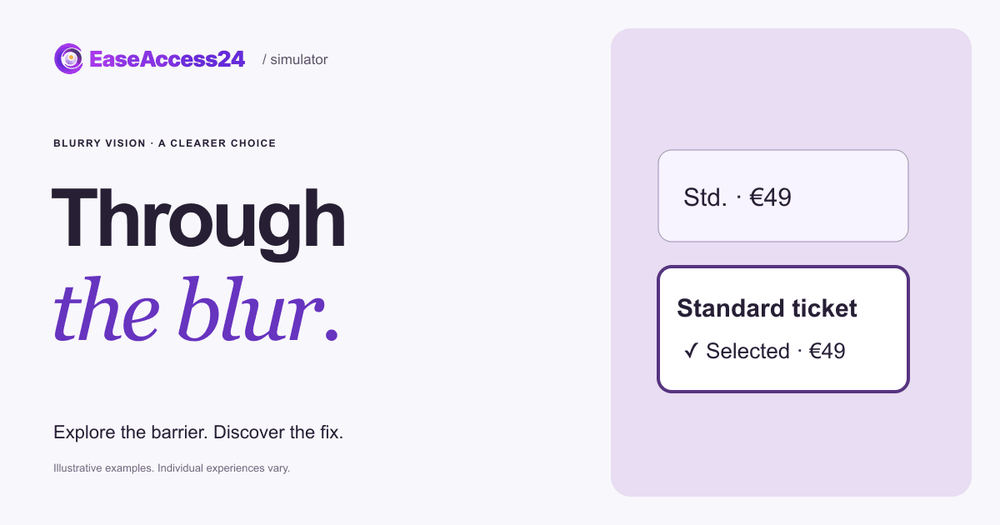
The Accessibility Simulator example Through the blur asks you to choose a Standard ticket for €49 on a fictional ticket site, then continue.
The page is shown through an illustrative blur. In the original design, tiny ticket symbols, cramped options and faint text turn the choice into a guess. Select Show the fix and the blur stays exactly the same, but the ticket cards are larger and clearly labeled, contrast is stronger, the spacing is more generous and the chosen option has an explicit "Selected" marker. Your choice carries over between versions.
The blur is an illustration, not a reproduction of any one person's vision. Individual experiences vary. The point of the example is that the person's vision did not change. The interface did.
How to design for blurry vision
These fixes help people with blurred vision, and also anyone using a small phone in bright sunlight. The relevant WCAG 2.2 success criteria are in brackets [10].
- Make targets big enough (2.5.8 Target Size (Minimum), Level AA). Pointer targets should be at least 24 by 24 CSS pixels, or have enough space around them. For key actions, aim for at least 44 by 44 CSS pixels, the Level AAA benchmark in 2.5.5 Target Size (Enhanced).
- Label icons and options with visible text. Write "Standard ticket, €49", not a symbol alone. Text survives blur far better than a small pictogram.
- Make the selected state obvious (1.4.1 Use of Color, Level A; 1.4.11 Non-text Contrast, Level AA). Use a checkmark, a thick border and the word "Selected", not only a color change or a hairline outline.
- Use strong contrast for prices and small print (1.4.3 Contrast (Minimum), Level AA). At least 4.5:1 for normal text. Check your secondary greys with our contrast checker; they often fail.
- Use a comfortable base font size and support enlargement (1.4.4 Resize Text, Level AA). Use relative units so people can scale text to 200% without content breaking.
- Give elements room (1.4.12 Text Spacing, Level AA). Generous spacing between options and lines stops labels merging together.
- Make focus easy to see (2.4.7 Focus Visible, Level AA). Keyboard users with blurred vision need a strong, clear focus indicator.
- Confirm important choices. Before payment, restate the chosen option in text ("Standard ticket, 1 × €49") so mistakes can be caught.
A quick scan with our accessibility checker will flag many contrast issues and some target-size problems. Judging whether icons are understandable without labels, or whether the selected state is obvious, needs a person looking at the real flow. Our complete guide to WCAG principles, levels and standards explains how these criteria and levels fit together.
What the European Accessibility Act means for blurry vision
The European Accessibility Act (Directive (EU) 2019/882) applies to products placed on the market and services provided to consumers after 28 June 2025, including e-commerce, consumer banking, e-books, electronic communications and elements of passenger transport services such as ticketing [11][12].
Several requirements in Annex I are directly relevant:
- Information about a service must be presented "in fonts of adequate size and suitable shape, taking into account foreseeable conditions of use and using sufficient contrast, as well as adjustable spacing between letters, lines and paragraphs" (Annex I, Section III, point (b)(v)).
- Websites and mobile applications must be made accessible "in a consistent and adequate way by making them perceivable, operable, understandable and robust" (Annex I, Section III, point (c)).
- Product user interfaces that use visual elements "shall provide for flexible ways of improving vision clarity" and for "flexible magnification, brightness and contrast" (Annex I, Section I, point 2(c) and (f)).
- At least one mode of operation must enable "users to operate the product with limited vision" (Annex I, Section VII, point (b)).
Web content in the EU is usually assessed against EN 301 549, which incorporates WCAG 2.1 Level AA [13]. Target Size (Minimum) is new in WCAG 2.2, so it goes beyond that baseline today, but it is a practical, measurable way to reduce errors for people with blurred vision. Contrast and Resize Text are Level AA in both versions.
Frequently asked questions
How common is myopia in Europe?
The E3 Consortium's meta-analysis of 15 European population studies found an age-standardized myopia prevalence of 30.6% among adults aged 25 to 89, and 47.2% among 25- to 29-year-olds. It estimated 227.2 million people with myopia across Europe [1].
Is blurry vision a disability?
Blurry vision that glasses fully correct is not usually considered a disability. But glasses are not always worn, prescriptions change, and conditions such as cataract cannot be corrected with glasses. In the EU's 2019 health interview survey, 18.1% of people aged 15+ reported some or severe difficulty seeing even with glasses or contact lenses [9]. Accessible design helps all of them, whether or not they think of themselves as disabled.
What is the minimum touch target size under WCAG 2.2?
Success criterion 2.5.8 Target Size (Minimum), Level AA, requires pointer targets of at least 24 by 24 CSS pixels, with exceptions such as adequate spacing, inline links and essential presentation. The Level AAA criterion 2.5.5 Target Size (Enhanced) sets 44 by 44 CSS pixels [10].
Why is cataract relevant to web design?
Cataract makes vision hazy and lowers contrast sensitivity, so faint text and thin lines are hard to read. It is common enough that cataract surgery is the most frequent operation recorded in EU hospitals, with over 5 million procedures in 2024 [7].
How can I check my checkout for these problems?
Go through the flow on a phone at arm's length, or with your glasses off if you wear them. Check whether every option has a text label, whether the selected option is obvious, and whether prices and small print pass contrast. For a full review, an accessibility audit tests contrast, labels, control sizes and spacing.
Next step
Book a ticket in the Through the blur example, then compare it with your own booking or checkout flow. Larger targets, visible labels and a clear selected state are some of the cheapest accessibility fixes you can ship.
Sources
- Williams KM, Verhoeven VJM, Cumberland P, et al. "Prevalence of refractive error in Europe: the European Eye Epidemiology (E3) Consortium." Eur J Epidemiol 2015;30(4):305–315. https://doi.org/10.1007/s10654-015-0010-0 (open access: https://europepmc.org/article/PMC/PMC4385146)
- Fricke TR, Tahhan N, Resnikoff S, et al. "Global Prevalence of Presbyopia and Vision Impairment from Uncorrected Presbyopia: Systematic Review, Meta-analysis, and Modelling." Ophthalmology 2018;125(10):1492–1499. https://pubmed.ncbi.nlm.nih.gov/29753495/
- World Health Organization. "Blindness and vision impairment" fact sheet, 10 February 2026. https://www.who.int/news-room/fact-sheets/detail/blindness-and-visual-impairment
- IAPB Vision Atlas. "Western Europe: GBD Region snapshot" (VLEG/GBD 2020 model), February 2021. https://www.iapb.org/wp-content/uploads/2021/02/Vision-Atlas_Western-Europe-Snapshot_24022021.pdf
- IAPB Vision Atlas. "Central Europe: GBD Region snapshot" (VLEG/GBD 2020 model), February 2021. https://www.iapb.org/wp-content/uploads/2021/02/Vision-Atlas_Central-Europe-Snapshot_24022021.pdf
- WHO Regional Office for Europe. "Vision and hearing loss" fact sheet, 30 January 2023. https://www.who.int/europe/news-room/fact-sheets/item/vision-and-hearing-loss
- Eurostat. Surgical procedures (hlth_co_proc3), cataract surgery, 2022–2024, https://ec.europa.eu/eurostat/databrowser/view/hlth_co_proc3/default/table ; and "Surgical operations and procedures statistics", Statistics Explained (data extracted February 2026), https://ec.europa.eu/eurostat/statistics-explained/index.php?title=Surgical_operations_and_procedures_statistics
- Eurostat. European Health Interview Survey (EHIS wave 3) Methodological manual, 2020 re-edition, question PL2. https://www.cso.ie/en/media/csoie/methods/irishhealthsurveyihs/EHIS_Wave_3_Methodological_Manual.pdf
- Eurostat. Functional limitations by sex, age and educational attainment level (hlth_ehis_pl1e), 2019, health problem "Seeing", people aged 15+. https://ec.europa.eu/eurostat/databrowser/view/hlth_ehis_pl1e/default/table
- W3C. Web Content Accessibility Guidelines (WCAG) 2.2, and Understanding SC 2.5.8 Target Size (Minimum). https://www.w3.org/TR/WCAG22/ and https://www.w3.org/WAI/WCAG22/Understanding/target-size-minimum.html
- Directive (EU) 2019/882 (European Accessibility Act), Articles 2, 4 and Annex I. https://eur-lex.europa.eu/eli/dir/2019/882/oj/eng
- European Commission. "European Accessibility Act." https://commission.europa.eu/strategy-and-policy/policies/justice-and-fundamental-rights/disability/union-equality-strategy-rights-persons-disabilities-2021-2030/european-accessibility-act_en
- W3C Web Accessibility Initiative. "Web Accessibility Laws & Policies: European Union." https://www.w3.org/WAI/policies/european-union/