Tiny buttons and slide-to-confirm controls look neat in a design file. For a customer with an unsteady hand, they can turn a two-tap task into a struggle.
Quick answer
Motor accessibility means people can use your website or app even if they cannot make small, precise or sustained movements. Conditions such as essential tremor, Parkinson's disease, arthritis and multiple sclerosis are common in Europe: a meta-analysis estimated essential tremor prevalence at 1.88% for European studies, and 16.3% of people aged 15 and over in the EU reported arthrosis (Eurostat, 2019). The key WCAG 2.2 fixes are larger targets (2.5.8 Target Size (Minimum), 24 by 24 CSS pixels), a single-pointer alternative to dragging (2.5.7 Dragging Movements) and full keyboard support (2.1.1 Keyboard).
Who is affected by motor barriers?
Motor disabilities are diverse. They can be permanent, progressive, fluctuating or temporary, and they affect people differently from day to day. Some of the groups most likely to struggle with small or precise controls are:
- People with tremor, including essential tremor and Parkinson's disease, whose hands shake involuntarily when reaching or holding still.
- People with arthritis, whose joints may be stiff or painful, making fine finger movements and sustained pressing difficult.
- People with multiple sclerosis, stroke, cerebral palsy or muscular dystrophy, who may experience weakness, spasticity, fatigue or reduced coordination.
- People with repetitive strain injuries or a temporary injury such as a broken wrist.
- Older people, for whom reduced dexterity and strength are more common.
- Anyone in a "situational" limitation: using a phone one-handed on a moving tram, wearing gloves, or holding a child.
Many people in these groups use a mouse or touch screen in the usual way, just less precisely. Others use a keyboard, a trackball, switches, head or eye tracking, or voice control.
How many people in Europe have motor disabilities?
There is no single official count of people in Europe with hand or upper-limb motor impairments. EU surveys ask about walking and self-care, but not about using hands and fingers, so the figures below combine Eurostat survey data with peer-reviewed estimates for specific conditions. Each figure is labelled with its population, year and method.
Condition-specific estimates:
- Essential tremor: a 2021 meta-analysis of 42 population-based studies from 23 countries estimated a pooled all-age prevalence of 1.33%. For the five European studies that reported mean age, the estimated prevalence was 1.88% (for a cohort with an average age of about 57). Among people aged 65 and over, the pooled prevalence was 5.79% (Louis and McCreary, 2021). Another 2021 meta-analysis using different methods reported a lower global figure of 0.32% (Song et al.), which shows how much estimates depend on case definitions.
- Parkinson's disease: WHO reports that global estimates in 2019 showed over 8.5 million people with Parkinson's disease worldwide. The EUROPARKINSON study, a joint analysis of five community surveys in France, Italy, the Netherlands and Spain with 14,636 participants aged 65 and over, found an age-adjusted prevalence of 1.6 per 100 people aged 65 and over. These surveys date from the 1990s, so current figures are likely higher as populations age; we could not find a recent, verified count for Europe as a whole.
- Multiple sclerosis: the Atlas of MS 2026 estimates 3.1 million people live with MS worldwide (38 per 100,000), with the highest prevalence in Europe and the Americas. The MS International Federation reported in 2020 that "more than 1 million people now live with MS in Europe", based on preliminary European MS Platform data.
- Arthritis and other rheumatic and musculoskeletal diseases: 16.3% of people aged 15 and over in the EU reported arthrosis (osteoarthritis) in the 2019 European Health Interview Survey. EULAR, the European Alliance of Associations for Rheumatology, states that "approximately one fourth of the EU population suffer from a RMD at some point in their lives".
Wider EU mobility and self-care data (EU-SILC 2025, people aged 16 and over, self-reported):
- 18.2% reported moderate or severe difficulty walking, and 5.7% severe difficulty. Applied to the EU population aged 16 and over on 1 January 2025 (381.6 million), that is about 69 million and 22 million people respectively (our calculation).
- 6.5% reported moderate or severe difficulty with self-care.
- Among people aged 75 and over, 57.7% reported difficulty walking and 26.0% difficulty with self-care.
Walking difficulty is not the same as difficulty using a mouse or touch screen. We include it because it is the best EU-wide, country-comparable measure of physical limitation, and because many of the same conditions affect both.
Country-level figures:
| Country | Difficulty walking, moderate or severe (2025) | Severe difficulty walking (2025) | Arthrosis reported (2019) |
|---|---|---|---|
| EU-27 | 18.2% | 5.7% | 16.3% |
| Germany | 21.9% | 7.3% | 16.5% |
| France | 14.4% | 5.3% | 23.4% |
| Italy | 14.2% | 4.8% | 18.5% |
| Spain | 20.9% | 6.6% | 15.1% |
| Poland | 18.6% | 5.2% | 15.5% |
| Netherlands | 16.0% | 4.8% | 16.1% |
| Belgium | 16.8% | 6.1% | 18.4% |
| Austria | 17.3% | 5.2% | 14.2% |
| Sweden | 17.9% | 4.2% | 15.3% |
| Denmark | 19.7% | 4.9% | 17.9% |
| Finland | 21.8% | 6.2% | 22.9% |
| Portugal | 14.2% | 6.0% | 23.8% |
Sources: walking difficulty from Eurostat ilc_hch19 (EU-SILC 2025, aged 16+); arthrosis from Eurostat hlth_ehis_cd1e (European Health Interview Survey 2019, aged 15+). All figures are self-reported; differences between countries partly reflect survey wording and interpretation.
How motor barriers show up on websites and apps
- Small, tightly packed targets. Quantity steppers, close icons, checkboxes and pagination links only a few pixels wide and placed right next to each other. A slight tremor hits the wrong one.
- Drag-only interactions. Slide-to-confirm, sliders for price ranges, drag-and-drop upload or reordering, and carousels that only respond to swiping.
- Complex gestures. Pinch, multi-finger or path-based gestures with no simple alternative.
- Actions triggered on press. If an action fires the moment a finger touches the screen, there is no chance to slide away from a mistaken tap.
- Time pressure. Short timeouts, auto-advancing carousels and fast-closing menus punish slower, deliberate movement.
- Hover-dependent menus. Menus that close as soon as the pointer drifts slightly away.
- Controls that do not work from the keyboard, which shuts out switch and keyboard users.
Try it yourself
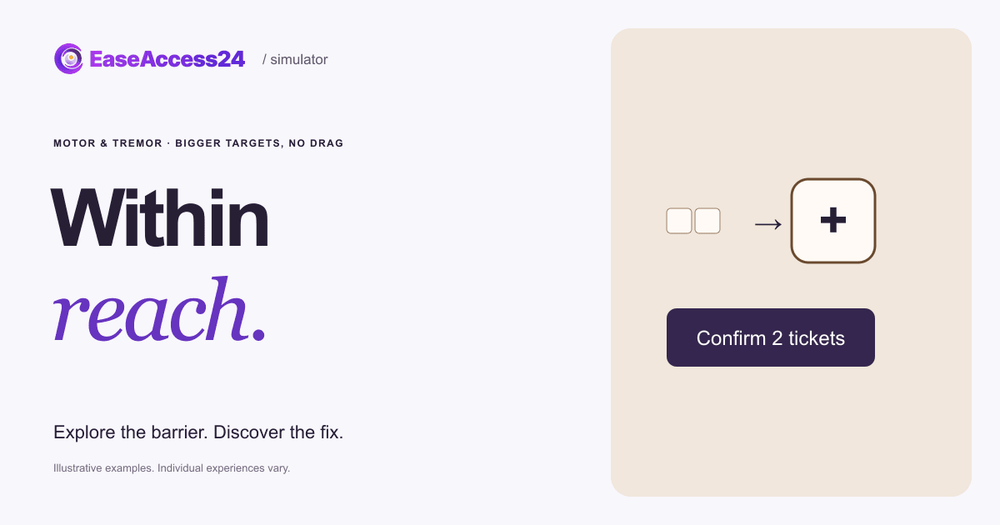
In our free Accessibility Simulator motor example, "Within reach", you book tickets for a fictional concert. Your task is to choose 2 tickets, then confirm.
In the inaccessible version, the minus and plus buttons are tiny and only 2 pixels apart, and booking needs a slide-to-confirm drag with no keyboard or single-tap alternative. An illustrative tremor nudges every tap a few pixels off target. When you select Show the fix, the tremor stays exactly the same, but the buttons become large and well spaced, and slide-to-confirm is replaced by a normal Confirm button. Your chosen quantity carries over, and you can switch between the versions to compare.
The tremor is an illustration, not a medical model. Motor disabilities vary widely, and this example shows one design barrier.
How to fix motor accessibility on your website
The WCAG 2.2 success criteria most often involved are given in brackets.
Make targets big enough
- Make pointer targets at least 24 by 24 CSS pixels, or make sure smaller targets have enough space around them that a 24-pixel circle centred on each does not overlap another target. (2.5.8 Target Size (Minimum), Level AA)
- For primary actions and anything on mobile, aim for 44 by 44 CSS pixels. (2.5.5 Target Size (Enhanced), Level AAA)
- Make the whole row, card or label clickable, not just a small icon. Associate every checkbox and radio button with its label so the label is part of the target.
Avoid drag-only and complex gestures
- Give every drag action a single-pointer alternative, such as plus and minus buttons for a slider, "Move up/Move down" buttons for reordering, or a normal button instead of slide-to-confirm. (2.5.7 Dragging Movements, Level AA)
- Make every multipoint or path-based gesture (pinch, swipe patterns) also work with a single tap or click. (2.5.1 Pointer Gestures, Level A)
- Trigger actions on release (the "up" event), not on touch, so people can slide away from an accidental press. (2.5.2 Pointer Cancellation, Level A)
- If shaking or tilting the device triggers something, provide a button alternative and a way to switch motion actuation off. (2.5.4 Motion Actuation, Level A)
Support other input methods and give people time
- Make every control work with a keyboard, which also supports switches and many voice and head-tracking tools. (2.1.1 Keyboard, Level A)
- Avoid tight time limits, or let users turn off, adjust or extend them. (2.2.1 Timing Adjustable, Level A)
- For purchases and other important submissions, let users review, confirm or undo before the action is final. (3.3.4 Error Prevention (Legal, Financial, Data), Level AA)
Test it
- Try your main journeys on a real phone, using only your non-dominant hand or a knuckle, and with a keyboard only.
Automated tools can measure some target sizes, but they cannot judge whether a drag has a real alternative. A free scan with the EaseAccess24 accessibility checker is a good start; an accessibility audit tests gestures and targets on real devices. If you want to understand how these criteria fit into WCAG as a whole, read our complete guide to WCAG principles, levels and standards.
What the European Accessibility Act means for motor accessibility
The European Accessibility Act (Directive (EU) 2019/882) applies to products placed on the market and services provided to consumers after 28 June 2025. Covered services include e-commerce, consumer banking, e-books, electronic communications, services providing access to audiovisual media, and elements of air, bus, rail and waterborne passenger transport services.
Several of its Annex I requirements address motor access directly:
- Usage with limited manipulation or strength: "Where the product or service requires manual actions, it shall provide at least one mode of operation that enables users to make use of the product through alternative actions not requiring fine motor control and manipulation, hand strength or operation of more than one control at the same time." (Annex I, Section VII, point (g), a functional performance criterion)
- Products with manual controls must "provide for sequential control and alternatives to fine motor control, avoiding the need for simultaneous controls for manipulation" (Annex I, Section I, point 2(h)).
- Websites and apps of covered services must be accessible "in a consistent and adequate way by making them perceivable, operable, understandable and robust" (Annex I, Section III, point (c)).
A slide-to-confirm control with no alternative, or a checkout built on tiny, crowded buttons, is hard to reconcile with these requirements. Microenterprises providing services (fewer than 10 employees and an annual turnover or balance sheet total of no more than EUR 2 million) are exempt from the service requirements, and enforcement is set by each country's national law. WCAG 2.2 Level AA, which includes 2.5.7 and 2.5.8, is the practical benchmark most teams use.
FAQ
What is the minimum target size in WCAG 2.2?
Success criterion 2.5.8 Target Size (Minimum), Level AA, requires pointer targets of at least 24 by 24 CSS pixels, unless there is enough spacing around smaller targets or another listed exception applies (for example, links inside a sentence). The enhanced criterion 2.5.5 asks for 44 by 44 CSS pixels.
Are sliders and drag-and-drop not allowed?
They are allowed, as long as there is also a way to do the same thing with a single pointer without dragging, such as buttons or a text field. That is what 2.5.7 Dragging Movements requires.
How common is tremor in Europe?
A 2021 meta-analysis estimated essential tremor prevalence at 1.88% across five European studies (for a cohort with an average age of about 57), and 5.79% among people aged 65 and over across all included studies. Tremor is also a common symptom of Parkinson's disease and can occur in multiple sclerosis.
Does keyboard access help people with motor disabilities?
Yes. Many people who cannot use a mouse precisely use a keyboard, switches, voice control or head tracking, and most of these tools depend on the page working from the keyboard (2.1.1 Keyboard).
Put your buttons within reach
Try the motor example in the simulator on your phone, then run your own pages through the free EaseAccess24 accessibility checker.
Sources
- Louis ED, McCreary M. How Common is Essential Tremor? Update on the Worldwide Prevalence of Essential Tremor. Tremor and Other Hyperkinetic Movements, 2021: https://pmc.ncbi.nlm.nih.gov/articles/PMC8269764/
- Song P, Zhang Y, Zha M, et al. The global prevalence of essential tremor, with emphasis on age and sex: a meta-analysis. Journal of Global Health, 2021: https://pmc.ncbi.nlm.nih.gov/articles/PMC8035980/
- WHO, Parkinson disease fact sheet (9 August 2023): https://www.who.int/news-room/fact-sheets/detail/parkinson-disease
- de Rijk MC, Tzourio C, Breteler MM, et al. Prevalence of parkinsonism and Parkinson's disease in Europe: the EUROPARKINSON Collaborative Study. Journal of Neurology, Neurosurgery and Psychiatry, 1997: https://pubmed.ncbi.nlm.nih.gov/9010393/
- MS International Federation, Atlas of MS 2026: 3.1 million people living with MS worldwide (September 2026): https://www.msif.org/wp-content/uploads/2026/09/Atlas-Epidemiology-report-text-core-data-2026-FINAL.pdf
- MS International Federation, Increase in MS prevalence in Europe (2020): https://www.msif.org/news/2020/06/24/increase-in-ms-prevalence-in-Europe/
- Eurostat, Persons reporting a chronic disease, by disease, sex, age and educational attainment level (hlth_ehis_cd1e), EHIS 2019: https://ec.europa.eu/eurostat/databrowser/view/hlth_ehis_cd1e/default/table
- EULAR, About EULAR advocacy: https://www.eular.org/about-eular-advocacy
- Eurostat, Persons reporting basic activity difficulty by sex, age, level of difficulty, type of basic action and risk of poverty threshold (ilc_hch19), EU-SILC 2025, people aged 16+: https://ec.europa.eu/eurostat/databrowser/view/ilc_hch19/default/table
- Eurostat, Population on 1 January by age and sex (demo_pjan), 2025: https://ec.europa.eu/eurostat/databrowser/view/demo_pjan/default/table
- W3C, Web Content Accessibility Guidelines (WCAG) 2.2: https://www.w3.org/TR/WCAG22/
- W3C, Understanding Success Criterion 2.5.7: Dragging Movements: https://www.w3.org/WAI/WCAG22/Understanding/dragging-movements.html
- Directive (EU) 2019/882 on the accessibility requirements for products and services (European Accessibility Act): https://eur-lex.europa.eu/eli/dir/2019/882/oj
- EaseAccess24 Accessibility Simulator, Within reach (motor and tremor): https://simulator.easeaccess24.com/simulate/motor/