Every popup, autoplaying video and chat prompt competes for attention. For many of your visitors, that competition decides whether they finish at all.
Quick answer
A global meta-analysis estimates that about 4.6% of adults in the WHO European Region have persistent ADHD, and around 7% have ADHD symptoms (Song et al., 2021). Popups, autoplaying media, chat prompts and mid-task offers pull people away from what they came to do, and getting back on track costs time and effort. WCAG 2.2 asks you to let people pause, stop or hide moving content (2.2.2) and, at AAA, to let them postpone interruptions (2.2.4). A calmer page helps everyone, and under the European Accessibility Act it is part of building an accessible checkout.
Most websites are not designed to distract. They become distracting one feature at a time: a cookie banner from legal, a newsletter popup from marketing, a chat bubble from support, an upsell from the sales team and an autoplaying hero video from the brand team. Each request is reasonable on its own. Together they turn a two-step task into an obstacle course.
For people with ADHD, and for many others with cognitive or learning disabilities, this is not a minor annoyance. It can be the difference between buying a ticket and closing the tab. This article looks at how many people in Europe are affected, what distractions do on real websites and how to design a calmer experience.
How many people in Europe have ADHD?
ADHD (attention deficit hyperactivity disorder) is a neurodevelopmental condition that affects attention, activity levels and impulse control. Prevalence figures vary widely depending on how ADHD is measured: by structured diagnostic interview, by recorded diagnosis, by prescriptions or by parent report. That is why figures from different countries should not be compared directly.
Europe-wide and global estimates
There is no official ADHD prevalence figure from the European Union, WHO/Europe or ADHD Europe. The best Europe-specific estimate comes from a peer-reviewed meta-analysis:
- 4.64% of adults in the WHO European Region have persistent ADHD (onset in childhood that continues into adulthood), and 7.12% have symptomatic ADHD (current symptoms, regardless of childhood onset). Song et al., Journal of Global Health, 2021. The European estimates are based on a limited number of studies with substantial variation between them.
- Globally, the same study estimates 2.58% of adults have persistent ADHD (about 140 million adults in 2020) and 6.76% have symptomatic ADHD (about 366 million).
- Among children and adolescents worldwide, ADHD prevalence is estimated at 3.4% (Polanczyk et al., 2015, meta-analysis of 41 studies in 27 countries).
- The WHO World Mental Health Surveys found current adult ADHD in 2.8% of adults aged 18–44 across 20 countries, and 3.6% in high-income countries (Fayyad et al., 2017).
In plain terms: roughly one adult in every 20 to 25 in Europe is likely to have persistent ADHD. Many more people, with or without a diagnosis, find it hard to stay on task when a page keeps interrupting them.
Country-level figures
The table brings together national figures from surveys, health registers and research studies. They measure different things, so read the "What it measures" column before comparing them.
| Country | Figure | What it measures | Source |
|---|---|---|---|
| France | 7.3% | Adults 18–44 with current ADHD, survey 2001–02 | Fayyad et al. 2017 (WHO WMH Surveys) |
| Netherlands | 5.0% | Adults 18–44 with current ADHD, survey 2002–03 | Fayyad et al. 2017 |
| Belgium | 4.1% | Adults 18–44 with current ADHD, survey 2001–02 | Fayyad et al. 2017 |
| Germany | 3.1% | Adults 18–44 with current ADHD, survey 2002–03 | Fayyad et al. 2017 |
| Portugal | 3.0% | Adults 18–44 with current ADHD, survey 2008–09 | Fayyad et al. 2017 |
| Italy | 2.8% | Adults 18–44 with current ADHD, survey 2001–02 | Fayyad et al. 2017 |
| Germany | 4.4% | Children 3–17 with a parent-reported ADHD diagnosis, KiGGS Wave 2 | Robert Koch Institute, 2018 |
| Germany | 1.1% | All ages with a recorded ADHD diagnosis in health insurance data, 2023 (about 918,000 people) | Betzler et al. 2026, Deutsches Ärzteblatt |
| Netherlands | 4.7% | Children 4–12 whose parents say they have ADHD or ADD, 2024 | Netherlands Youth Institute (NJi) |
| Sweden | 2.3% / 2.4% | Women / men who collected ADHD medication, 2024 | Socialstyrelsen |
| Denmark | 9.8% / 7.4% | Boys / girls diagnosed with ADHD or prescribed ADHD medication by age 18 | Bliddal et al. 2026, national registers |
The Fayyad et al. survey figures are 15 to 25 years old and the authors note that their method may bias comparisons between countries. Register and prescription figures count only people who have been diagnosed or treated, and diagnosis rates have risen sharply in several countries in recent years.
How distractions affect people using websites
The W3C guidance Making Content Usable for People with Cognitive and Learning Disabilities includes an objective called "Help users focus". It states plainly: "Distractions can prevent users with cognitive and learning disabilities from completing their tasks." Common culprits on European websites include:
- Stacked popups on arrival. A cookie banner, then a newsletter signup, then a discount offer, all before the visitor has seen the page they asked for.
- Interruptions mid-task. A chat prompt sliding in during checkout, an "Are you sure you want to leave?" overlay, or a survey that appears while someone is filling in a form.
- Autoplaying video and audio. Moving or noisy content near the main task constantly pulls the eye and ear away from it.
- Carousels and tickers that change every few seconds, so the visitor loses their place or misses the item they were reading.
- Competing calls to action. Five buttons of equal weight on one step, so it is unclear which one moves the task forward.
- Elements covering the content. Sticky banners, chat bubbles and cookie notices that hide the button or field someone is trying to use, especially on mobile and at high zoom.
- Lost progress. Closing a dialog or going back a step resets the choices someone already made, so they must start again after every distraction.
Each interruption has a cost: the visitor must notice it, decide what to do, dismiss it and then remember where they were. For someone with ADHD, the last step can be the hardest. The same patterns also affect people with anxiety, autistic people who are sensitive to movement and sound, people with brain injuries, older users and anyone using a phone on a busy train.
Try it yourself
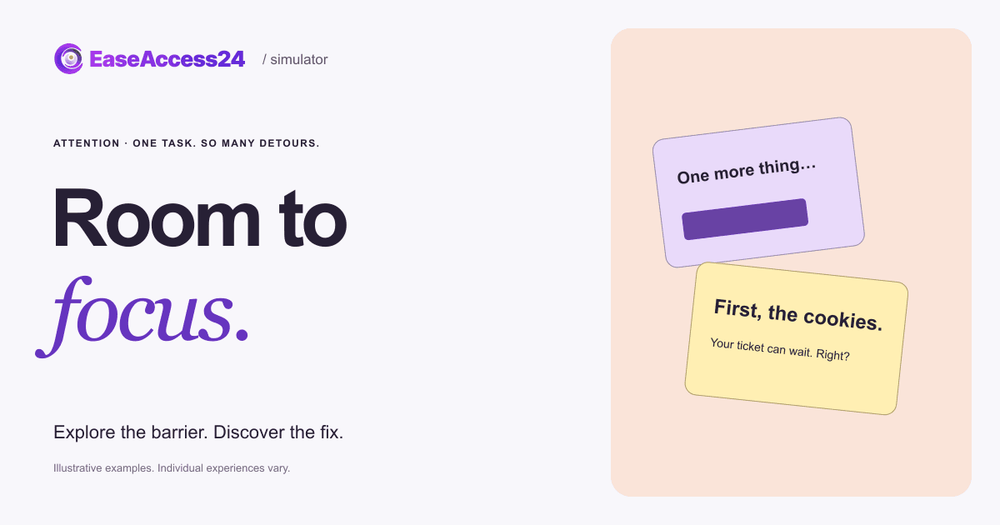
Our free interactive example, Room to focus, asks you to do one simple thing on a fictional concert ticket site: choose a standard ticket and continue.
In the inaccessible version, a cookie banner, a newsletter popup, a chat bubble and a travel offer all compete for your attention before you reach Continue. You can try to stay on task, or follow a distraction and see where it leads. Their buttons lead to more distractions, without submitting anything real. The popups are animated, and you can pause them at any time.
Select Show the fix and the same booking step becomes calm: unrelated popups and offers are gone, the next step is clear and your ticket choice is kept. You can switch between the two versions as often as you like.
The example deliberately exaggerates an environmental barrier so you can feel it in seconds. It does not reproduce what it is like to have ADHD, and everyone's experience is different. What it shows is that the page, not the person, is what changes.
How to make your website ADHD-friendly
You don't need a separate "ADHD mode". Most improvements are simply good, focused design. Use this checklist, with the related WCAG 2.2 success criteria:
- Keep critical journeys free of interruptions. Don't open newsletter popups, chat prompts, surveys or upsells during checkout, sign-up or payment. Let people postpone or turn off non-urgent interruptions. (2.2.4 Interruptions, Level AAA)
- Let people pause, stop or hide anything that moves. Any content that moves, blinks, scrolls or auto-updates for more than five seconds alongside other content needs a way to pause, stop or hide it. That includes carousels, tickers and animated banners. (2.2.2 Pause, Stop, Hide, Level A)
- Don't autoplay sound. If audio plays automatically for more than three seconds, provide a way to pause it or control its volume. Better still, don't autoplay at all. (1.4.2 Audio Control, Level A)
- Don't change context unexpectedly. Focusing a field or choosing an option shouldn't open new windows, submit forms or move people to another page without warning. (3.2.1 On Focus and 3.2.2 On Input, Level A)
- Never hide what people are working on. Sticky headers, cookie notices and chat widgets must not completely cover the element that has keyboard focus. (2.4.11 Focus Not Obscured (Minimum), Level AA, new in WCAG 2.2)
- Give each step one clear primary action, with secondary options visually quieter. Short, predictable paths reduce the chance of getting lost (W3C cognitive objective "Help users focus").
- Keep people's choices. If someone closes a dialog, goes back a step or gets interrupted, keep what they entered. Don't ask for the same information twice in one process. (3.3.7 Redundant Entry, Level A, new in WCAG 2.2)
- Respect reduced-motion settings. Honour the operating system's "reduce motion" preference and let people turn off non-essential animation triggered by interaction. (2.3.3 Animation from Interactions, Level AAA)
- Design consent banners calmly. In the EU you usually can't remove cookie consent, but you can show it once, keep it short and readable, make the choices equally clear, and avoid stacking other popups on top of it.
- Put help in the same place on every page, rather than in a chat bubble that pops open by itself. (3.2.6 Consistent Help, Level A, new in WCAG 2.2)
Some of these issues, such as missing pause controls or focus hidden behind a banner, can be detected with an automated scan, for example our free accessibility checker. Others, such as whether an interruption appears at the wrong moment, need a person to walk through the journey, which is what an accessibility audit does. If the A, AA and AAA levels are new to you, our guide to WCAG principles and levels explains them.
What the European Accessibility Act means for distracting design
The European Accessibility Act (Directive (EU) 2019/882) has applied since 28 June 2025. It covers e-commerce services, defined as services provided at a distance through websites and mobile apps with a view to concluding a consumer contract, along with services such as banking, e-books and passenger transport ticketing.
The Act requires covered websites and apps to be perceivable, operable, understandable and robust. It does not name WCAG directly; conformity is normally shown through the harmonised European standard EN 301 549. The currently cited version, V3.2.1, is based on WCAG 2.1 Level AA. A new version, V4.1.1, published in September 2026, aligns with WCAG 2.2 Level AA and is expected to be cited in the Official Journal of the EU in December 2026.
In practice:
- 2.2.2 Pause, Stop, Hide, 1.4.2 Audio Control, 3.2.1 On Focus and 3.2.2 On Input are Level A and part of the baseline today.
- 2.4.11 Focus Not Obscured (Minimum) and 3.3.7 Redundant Entry are new in WCAG 2.2 and become part of the baseline as the WCAG 2.2-based standard takes effect.
- 2.2.4 Interruptions is Level AAA. It is not usually required, but it is the clearest description of what calm, ADHD-friendly design looks like.
FAQ
Do I have to remove all popups to be accessible?
No. Popups are not banned by WCAG. The problems are interruptions people can't postpone, popups that hide the content they're using, dialogs that trap keyboard focus and choices that are lost when a dialog closes. Keep essential dialogs, remove unnecessary ones and never interrupt a critical task such as payment.
Is autoplaying video an accessibility problem?
It can be. Under WCAG 2.2.2, moving content that lasts more than five seconds and appears alongside other content needs a pause, stop or hide control. Under 1.4.2, audio that plays automatically for more than three seconds needs a way to pause it or control the volume. Autoplay also makes it harder for many people to concentrate on the rest of the page.
Can we still use a cookie banner on an ADHD-friendly site?
Yes. Cookie consent is usually a legal requirement in the EU. Make it short, readable and keyboard accessible, make sure it doesn't cover focused content, and don't stack newsletter or discount popups on top of it.
Is there a WCAG success criterion specifically for ADHD?
WCAG doesn't group criteria by condition. Several criteria help people with attention difficulties, especially 2.2.2 Pause, Stop, Hide, 2.2.4 Interruptions and 3.3.7 Redundant Entry. The W3C supplemental guidance on cognitive accessibility goes further, with an objective dedicated to helping users focus.
A calmer website doesn't mean a duller one. It means every element on the page earns its place. If you'd like help finding what pulls your customers away mid-journey, our team can review your key flows.
Sources
- Song P, et al. "The prevalence of adult attention-deficit hyperactivity disorder: A global systematic review and meta-analysis." Journal of Global Health, 2021;11:04009: https://pmc.ncbi.nlm.nih.gov/articles/PMC7916320/
- Fayyad J, et al. "The descriptive epidemiology of DSM-IV Adult ADHD in the World Health Organization World Mental Health Surveys." ADHD Attention Deficit and Hyperactivity Disorders, 2017;9(1):47–65: https://pmc.ncbi.nlm.nih.gov/articles/PMC5325787/
- Polanczyk GV, et al. "Annual research review: A meta-analysis of the worldwide prevalence of mental disorders in children and adolescents." Journal of Child Psychology and Psychiatry, 2015;56(3):345–365: https://europepmc.org/article/MED/25649325
- Göbel K, et al. "ADHS bei Kindern und Jugendlichen in Deutschland – Querschnittergebnisse aus KiGGS Welle 2 und Trends." Journal of Health Monitoring, Robert Koch Institute, 2018: https://edoc.rki.de/handle/176904/5768
- Betzler F, et al. "ADHD in Children, Adolescents, and Adults: Incidence, Prevalence, and Treatment. An Analysis of Routine Health Insurance Data." Deutsches Ärzteblatt International, 2026;123:275–280: https://di.aerzteblatt.de/int/archive/article/249978
- Netherlands Youth Institute (NJi), "Cijfers over ADHD": https://www.nji.nl/databanken/cijfers/cijfers-over-adhd
- Socialstyrelsen, "Fortsatt ökning av adhd-läkemedel – särskilt bland unga kvinnor" (23 April 2025): https://www.socialstyrelsen.se/om-socialstyrelsen/pressrum/press/fortsatt-okning-av-adhd-lakemedel--sarskilt-bland-unga-kvinnor/
- Bliddal M, et al. "Trends and incidence rates of neurodevelopmental disorders in Danish children and adolescents 2000-2024." European Child & Adolescent Psychiatry, 2026;35(5):1667–1675: https://portal.findresearcher.sdu.dk/en/publications/trends-and-incidence-rates-of-neurodevelopmental-disorders-in-dan/
- W3C, "Making Content Usable for People with Cognitive and Learning Disabilities" (Working Group Note): https://www.w3.org/TR/coga-usable/
- W3C WAI, "Cognitive Accessibility Objective: Help Users Focus": https://www.w3.org/WAI/WCAG2/supplemental/objectives/o5-user-focus/
- W3C, Understanding WCAG 2.2: 2.2.2 Pause, Stop, Hide: https://www.w3.org/WAI/WCAG22/Understanding/pause-stop-hide.html
- W3C, Understanding WCAG 2.2: 2.2.4 Interruptions: https://www.w3.org/WAI/WCAG22/Understanding/interruptions.html
- Directive (EU) 2019/882 (European Accessibility Act): https://eur-lex.europa.eu/eli/dir/2019/882/oj
- National Disability Authority (Ireland), "EN 301 549 V4.1.1 published": https://nda.ie/news/en301549-published