Generative engine optimization (GEO): where accessibility fits
AI-generated answers can sit between your customers and your website. Here is what generative engine optimization means, and which accessibility practices make your content easier to quote.
Quick answer
Generative engine optimization (GEO) is the work of making your content easy for AI answer tools to find, understand and cite. These tools pull passages from web pages and combine them into one answer. Content is easier to quote when it gives direct answers in text, with clear headings, labelled tables and text alternatives. Accessibility standards require much of the same structure. GEO can make your content more quotable, but no one can promise that an AI answer will cite you.
What is generative engine optimization?
Generative engine optimization is the practice of shaping your content so AI answer tools can use and cite it. A "generative engine" is any search or assistant tool that writes an answer instead of only listing links.
Traditional SEO aims for a place in a list of results. GEO aims for a place inside the answer itself, usually as a quoted passage or a cited source.
For a CMO, the shift is simple. When a question is answered on the spot, the visitor may never click, so the content behind the answer matters more.
How do AI answers choose what to quote?
An AI answer is built from passages, not whole pages. In general terms, an answer that cites sources is built in three steps.
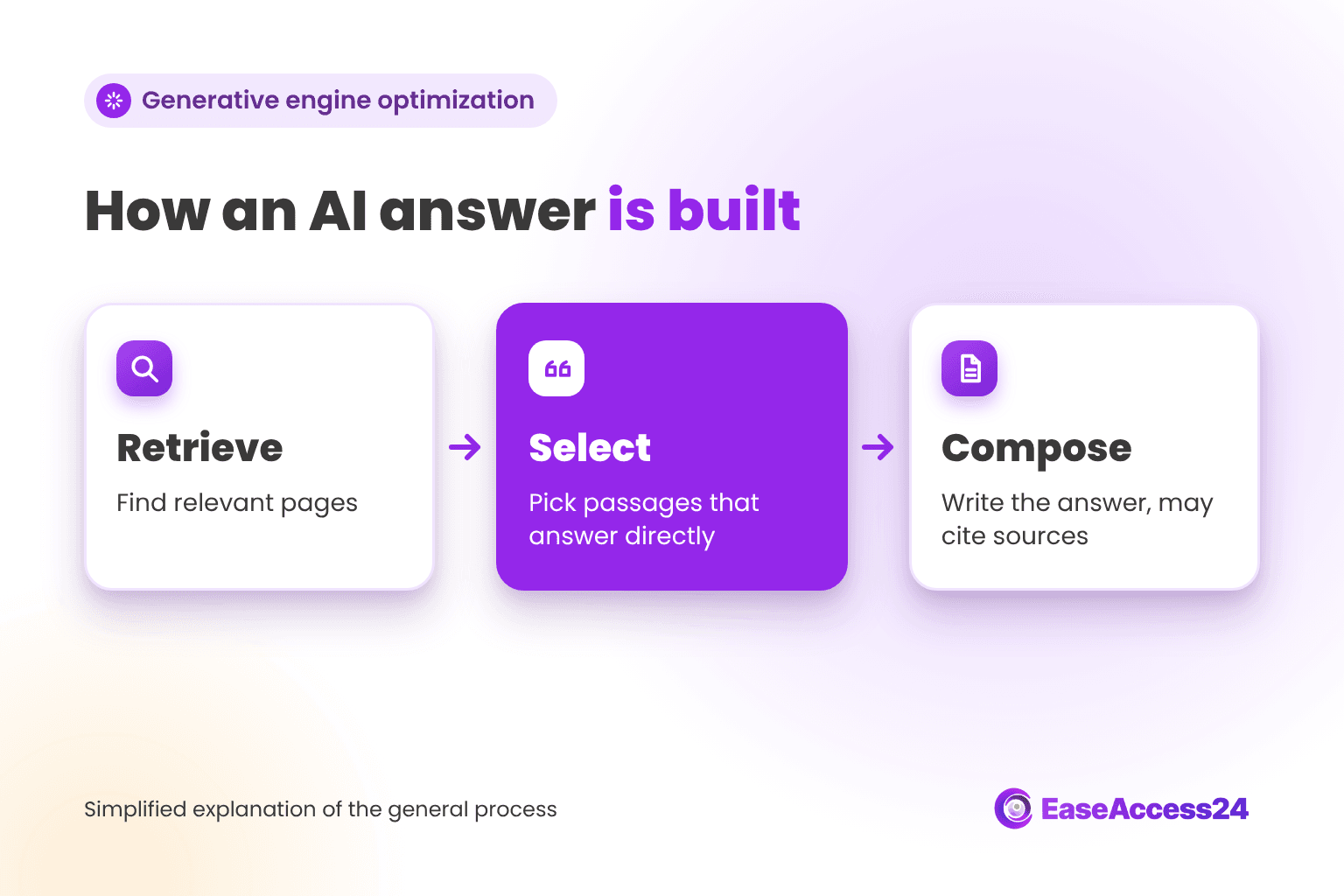
- Retrieve. The tool finds pages that seem relevant to the question.
- Select. It picks the passages that answer the question most directly.
- Compose. It writes an answer from those passages and may link to the sources.
The selection step is where structure counts. A passage is easier to reuse when it makes sense on its own, without the paragraphs around it.
The exact signals each tool uses are not public in full, and they change. What we can explain is the mechanism: clear, self-contained, well-labelled text is easier to extract than text that depends on layout.
Where does accessibility fit in GEO?
Accessibility makes the meaning of your page available as text and structure, which is what an AI answer tool extracts. WCAG 2.2 success criterion 1.3.1 requires that structure and relationships shown visually "can be programmatically determined or are available in text".
Here is how common GEO goals line up with accessibility requirements:
| GEO goal | Accessibility practice | WCAG 2.2 |
|---|---|---|
| The tool can tell what each section covers | Headings that describe the topic | 2.4.6 Headings and Labels |
| Sections and lists are recognised as such | Real headings, lists and tables in the code | 1.3.1 Info and Relationships |
| Facts in images and charts can be quoted | Text alternatives for non-text content | 1.1.1 Non-text Content |
| Spoken content in video can be quoted | Captions or transcripts | 1.2.2 Captions (Prerecorded) |
| Cited links make sense out of context | Link text that says where it goes | 2.4.4 Link Purpose (In Context) |
| The page's topic and language are clear | Descriptive title and declared language | 2.4.2 Page Titled, 3.1.1 Language of Page |
The W3C makes the same link for alt text. Its introduction to web accessibility says alt text is available "to technologies that cannot see images, such as search engines". The same applies to any tool that works from text.
Our article on how web accessibility helps your SEO covers the classic search side of this overlap.
How is GEO different from SEO?
GEO builds on SEO; it doesn't replace it. Pages still need to be found before any tool can quote them.
| SEO | GEO | |
|---|---|---|
| Goal | Rank in a list of results | Be used or cited inside an AI answer |
| Unit that matters | The page | The passage |
| Success looks like | Clicks from search results | Citations, mentions and visits from answers |
| Content style that helps | Relevant, well-structured pages | Direct answers that stand on their own |
| Where accessibility helps | Alt text, headings, link text | The same, plus labelled tables and transcripts |
Both start with how models read a page in the first place. Our article on LLM SEO and how AI models read your website covers that step.
How do you write content that AI answers can quote?
Write each section so its first sentence answers the heading's question. That sentence can then be lifted into an answer without losing its meaning.
- Phrase headings as real questions. Use the words your customers search with.
- Define key terms in one sentence. "X is…" sentences are easy to reuse.
- Put data in labelled tables, not images. Table headers tell the reader what each value means.
- Avoid "as shown above". A quoted passage loses its surroundings.
- Add a short summary at the top. A quick answer block gives tools a ready-made passage.
None of this is a trick. The same habits make pages easier for people who skim, use assistive technology or read on small screens.
What can't accessibility do for GEO?
Accessibility makes your content readable; it doesn't make it chosen. AI answer tools also weigh relevance, quality and many signals that are not public.
An accessible page with thin content will not be quoted for its structure alone. And a perfect automated score only means the scanner found no problems it can detect. Honest expectations protect your budget and your brand.
What this means for your business
- Find your structural gaps. Run a free scan with our accessibility checker to spot missing alt text, empty links and heading issues.
- Rewrite your key pages answer-first. Start with the pages that answer your customers' most common questions.
- Move data out of images. Prices, specifications and comparisons belong in text and tables.
- Brief your developers. Our complete guide to WCAG explains the requirements in technical terms.
- Count compliance as a second return. For many businesses selling online in the EU, accessibility is a legal duty. See EAA fines by country.
Frequently asked questions
What is generative engine optimization?
Generative engine optimization (GEO) is the practice of making content easy for AI answer tools to use and cite. It focuses on clear, self-contained passages and readable structure.
Is GEO the same as SEO?
No. SEO aims for rankings in a list of results; GEO aims for a place inside an AI-generated answer. GEO builds on SEO, because a page must be found before it can be quoted.
Does accessibility help GEO?
Accessible pages expose their structure and meaning as text, which is what AI answer tools extract. It makes content easier to use, but it doesn't guarantee a citation.
How do I get cited in AI answers?
No one can guarantee it. You can make your content easier to quote with direct answers, clear headings and data in text rather than images.
Can GEO be measured?
Partly. Your analytics may show visits referred from AI tools, where the tool passes that information. There is no complete public record of how often each tool cites you.
Related
- How web accessibility helps your SEO: the search engine side of accessibility
- The complete guide to WCAG: the standard behind accessible structure
- EAA fines by country: what accessibility failures can cost in the EU
- Official text: WCAG 2.2 (W3C)