LLM SEO starts with one question: what do AI models actually read on your website? Here is the answer, and why accessible structure makes your content easier to interpret.
Quick answer
LLM SEO is the work of making your pages easy for large language models and their crawlers to read and interpret correctly. These systems mostly work from text and code, not from the visual design. Headings, lists, tables, link text and text alternatives tell them what each part of a page is. Those are the same things accessibility standards require, so an accessible page is also a clearer page for AI. No one can promise how a model will use your content, but you control how readable it is.
What is LLM SEO?
LLM SEO is the practice of making your content easy for large language models to read, interpret and represent accurately. It focuses on the input side: what a model can extract from your page.
A large language model (LLM) is software trained on large amounts of text to understand and generate language. AI assistants and AI search features are built on them.
LLM SEO doesn't replace traditional SEO. It adds a question your team may not have asked yet: if all the styling were gone, would your page still make sense?
How do AI models read a website?
AI models read a website as text and structure, not as a designed page. Automated readers usually work in three steps.
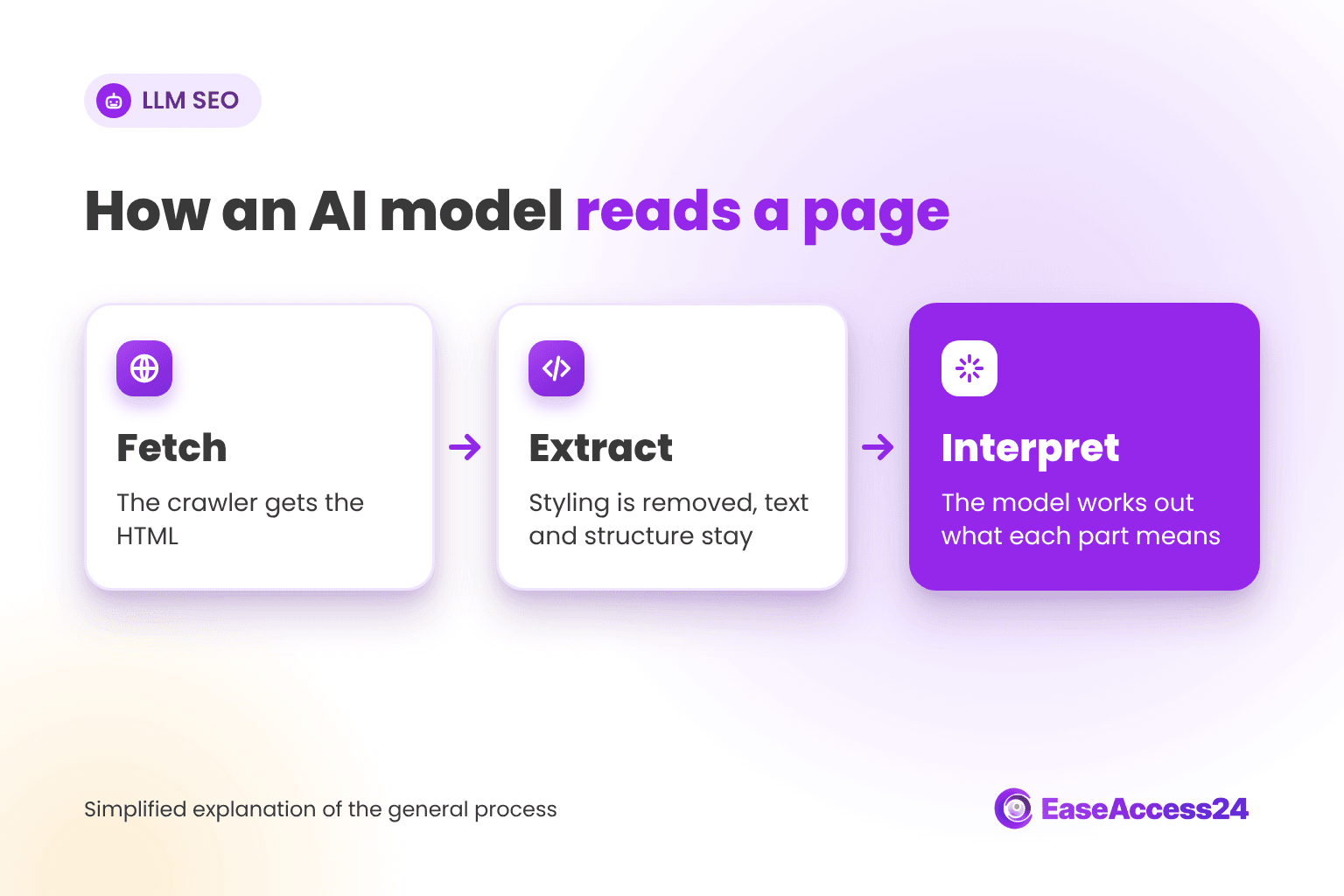
- Fetch. A crawler requests the page and receives its HTML code.
- Extract. The software strips out styling and layout and keeps the text and its structure.
- Interpret. The model works out what the page is about, how its parts relate and what each element does.
What survives step 2 is what the model gets. Large bold text is just another sentence once styling is gone; a real heading keeps its meaning.
Some readers fetch the raw HTML and may not run your scripts. Content that only appears after scripts run can be harder for them to see. Key text that is present in the HTML is the safer choice.
What is the accessibility tree, and why does it matter for AI?
The accessibility tree is a structured version of your page that the browser builds for assistive technology. The W3C's WAI-ARIA specification defines it as a "tree of accessible objects that represents the structure of the user interface".
Each node has a role, such as heading, link or button, and a name. The W3C's HTML mapping specification sets these roles for standard HTML. For example, <nav> maps to the navigation role and <h2> to a heading at level 2.
That is exactly the kind of information a model needs. Software that reads the code or the accessibility tree learns what each element is, not just what it looks like. A screen reader relies on this structure, and any other automated reader can use the same signals.
Why does accessible structure help LLM SEO?
Accessibility standards require information to be readable by software, not just by eyes. WCAG 2.2 success criterion 1.3.1 says information, structure and relationships shown visually must be "programmatically determined or are available in text".
WCAG defines "programmatically determined" as "determined by software from author-supplied data". That definition describes how any automated reader works, including the crawlers that feed AI models.
Here is how the main accessibility requirements map to what a text-only reader receives:
| Page element | What a visitor sees | What a text-only reader gets if it's done right | WCAG 2.2 |
|---|---|---|---|
| Image | The picture | A text alternative that describes it | 1.1.1 Non-text Content |
| Video | Moving pictures and sound | Captions or a transcript | 1.2.2 Captions (Prerecorded) |
| Heading | Large, bold text | A heading with its level | 1.3.1 Info and Relationships |
| Table | Rows and columns | Headers linked to their data | 1.3.1 Info and Relationships |
| Link | Underlined text | Link text that says where it goes | 2.4.4 Link Purpose (In Context) |
| Page | A styled page | A descriptive title and a declared language | 2.4.2 Page Titled, 3.1.1 Language of Page |
The W3C's introduction to web accessibility makes the same point about images. Alt text is available to people who can't see the image, and "to technologies that cannot see images, such as search engines".
What do AI crawlers miss on a typical page?
AI crawlers miss anything that only exists visually. These are the most common gaps:
- Text inside images. Prices, offers or charts saved as pictures carry no readable text without a text alternative.
- Fake headings. Styled paragraphs look like headings but give no structure.
- Vague links. "Read more" and "Click here" say nothing about the destination out of context.
- Video without transcripts. Spoken content stays locked in the audio.
- Meaning shown by colour or position only. "Items in green are in stock" means nothing in plain text.
Each of these is also an accessibility problem. One fix helps people using assistive technology and automated readers alike.
Is LLM SEO different from traditional SEO?
LLM SEO overlaps heavily with traditional SEO but asks a different question. Traditional SEO asks how a search engine indexes and ranks your page. LLM SEO asks how well a model can extract and interpret what your page says.
Many of the basics are shared: clear headings, descriptive alt text and meaningful link text. Our article on how web accessibility helps your SEO covers that overlap for search engines.
No method guarantees that an AI model will mention or recommend you. Models also weigh content quality, relevance and many other signals. What you can control is whether your content is readable when it is used.
What this means for your business
- Test your pages. Run a free scan with our accessibility checker to find missing alt text, empty links and heading problems. Automated scans don't catch everything, so a good score is not the same as being accessible.
- Put key content in text. Prices, product details and offers should be real text, not images.
- Use real structure. Ask your developers for real headings, lists and tables, as described in our complete guide to WCAG.
- Add transcripts and captions. Spoken content becomes readable text.
- Treat it as compliance too. For many businesses selling online in the EU, accessibility is a legal requirement. See EAA fines by country.
Frequently asked questions
What is LLM SEO?
LLM SEO is the practice of making your website easy for large language models to read and interpret correctly. It focuses on clear text, real structure and text alternatives for non-text content.
How do AI models read websites?
They work from the page's text and code, not its visual design. Headings, lists, tables, link text and alt text tell them what each part of the page is.
Does accessibility help LLM SEO?
Accessible pages make their structure and meaning available to software, which is what an AI model needs to interpret them. It doesn't guarantee that a model will use or mention your content.
Can AI models read images on my website?
The reliable route is a text alternative that describes the image. WCAG requires one for non-text content, with a few listed exceptions such as decoration.
Is LLM SEO the same as SEO?
No, but they overlap. SEO is about being indexed and ranked by search engines; LLM SEO is about being read and interpreted correctly by language models.
Related
- How web accessibility helps your SEO: the search engine side of accessibility
- The complete guide to WCAG: the standard behind accessible structure
- EAA fines by country: what accessibility failures can cost in the EU
- Official text: WCAG 2.2 (W3C)