The European Accessibility Act explained: who it covers, what it requires, when it applies
The European Accessibility Act (EAA) sets accessibility rules for products and services sold to consumers in the EU. Here is what the directive says, in plain words.
Quick answer
The European Accessibility Act is Directive (EU) 2019/882. It covers listed products and consumer services, including e-commerce, consumer banking, e-books, passenger transport websites and apps, and electronic communications. National laws implementing it apply since 28 June 2025. Microenterprises providing services are exempt from the service requirements. Each EU country sets its own penalties.
What is the European Accessibility Act?
The European Accessibility Act is an EU directive that sets common accessibility requirements for certain products and services. It was adopted on 17 April 2019 as Directive (EU) 2019/882.
A directive doesn't apply to your business directly. Each EU country writes its own law to implement it, such as the Barrierefreiheitsstärkungsgesetz (BFSG) in Germany. The obligations you follow are in the national law of each country where you sell.
Who does the European Accessibility Act apply to?
The EAA applies to businesses that make, import, distribute or provide the products and services it lists. The directive calls them "economic operators" (Article 3).
For services, the key word is consumers. Article 2(2) covers listed services "provided to consumers after 28 June 2025". Two consequences follow:
- You don't need to be based in the EU. A service provider is anyone who provides or offers services "to consumers in the Union" (Article 3).
- Purely business-to-business services are generally outside the service rules. If you sell to both businesses and consumers, the consumer side is covered.
Which services are covered?
| Service | What the EAA covers (Article 2(2)) |
|---|---|
| E-commerce | Selling to consumers at a distance through websites and apps |
| Consumer banking | Consumer credit, payment services, payment accounts, e-money and some investment services |
| Passenger transport (air, bus, rail, waterborne) | Websites, apps, e-tickets, travel information and self-service terminals |
| Electronic communications | Electronic communications services, except machine-to-machine transmission |
| Access to audiovisual media | Websites, apps and electronic programme guides that give access to TV and video |
| E-books | E-books and the dedicated software to read them |
E-commerce is the widest category. Article 3 defines it as services provided "through websites and mobile device-based services" with "a view to concluding a consumer contract". If consumers can buy from you online, your website or app is likely in scope.
Which products are covered?
Article 2(1) covers products placed on the market after 28 June 2025: consumer computers and their operating systems, payment terminals, ATMs, ticketing and check-in machines, interactive information terminals, consumer devices for electronic communications and audiovisual media, and e-readers.
What does the EAA require for websites and apps?
Websites and apps must be perceivable, operable, understandable and robust. Annex I, Section III(c) requires making websites and mobile apps accessible "in a consistent and adequate way by making them perceivable, operable, understandable and robust".
These are the four principles of the Web Content Accessibility Guidelines (WCAG), although the directive doesn't name WCAG. Instead, Article 15 says services that meet harmonised standards published in the Official Journal of the EU are presumed to conform. Our complete guide to WCAG explains the principles.
The EAA also asks service providers to:
- Publish accessibility information. Article 13(2) and Annex V require a description of how the service meets the requirements, in your general terms and conditions or an equivalent document.
- Stay accessible over time. Article 13(3) requires procedures so the service "remains in conformity".
- Fix problems and report them. If the service stops conforming, Article 13(4) requires you to fix it and inform the national authorities immediately.
When does the European Accessibility Act apply?
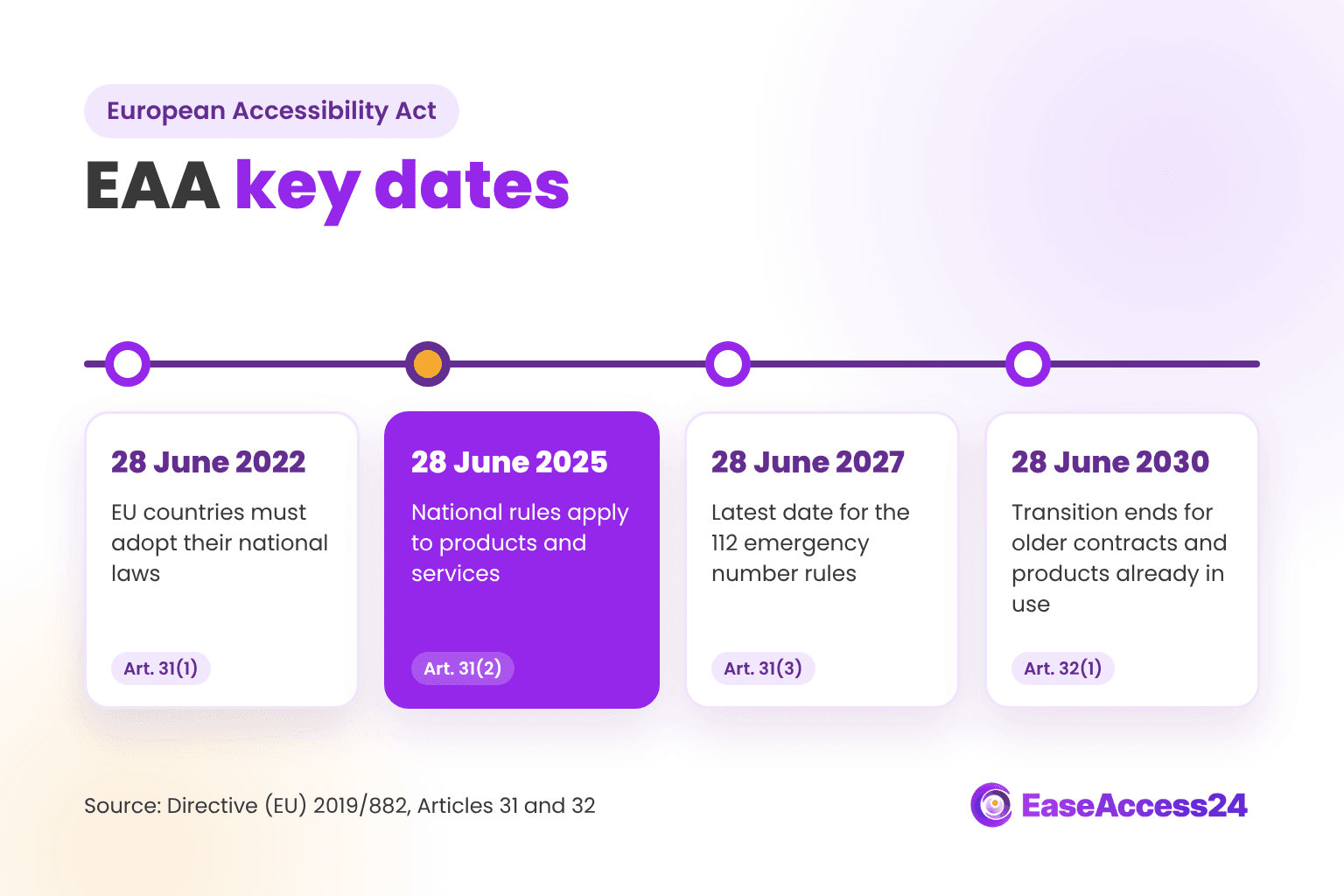
The national laws apply from 28 June 2025. Countries had to adopt them by 28 June 2022 (Article 31).
| Date | What happens | Source |
|---|---|---|
| 28 June 2022 | Deadline for EU countries to adopt their laws | Article 31(1) |
| 28 June 2025 | National rules apply | Article 31(2) |
| 28 June 2027 | Latest date for the 112 emergency number rules, if a country delays them | Article 31(3) |
| 28 June 2030 | Transition ends for products already used to provide services, and for contracts agreed before 28 June 2025 | Article 32(1) |
The 2030 transition is not a general grace period for websites. It covers products a service provider already used before 28 June 2025, and older service contracts. Self-service terminals already in use may stay in use until the end of their useful life, up to 20 years after first use, if the country allows it (Article 32(2)).
Are there exemptions to the EAA?
Yes, but they are narrow and each has conditions.
- Microenterprises providing services are exempt from the service requirements (Article 4(5)). A microenterprise has fewer than 10 employees and an annual turnover or balance sheet total of no more than €2 million (Article 3). Microenterprises that make or sell products are not exempt.
- Fundamental alteration or disproportionate burden can limit the requirements (Article 14). You must document the assessment, keep it for five years and show it to the authorities on request. Service providers must renew it at least every five years.
- Some content is excluded (Article 2(4)): pre-recorded media and office files published before 28 June 2025, archives not edited since then, some online maps, and third-party content you don't fund, develop or control.
The content dates matter. A PDF published before 28 June 2025 is excluded; a new one is not.
What are the fines under the EAA?
There is no single EU fine. Article 30 tells each country to set penalties that are "effective, proportionate and dissuasive", taking into account how serious the breach is and how many people are affected.
Paying a fine doesn't end the obligation. Penalties must come with "effective remedial action" (Article 30(2)), so you still have to fix the problem. Consumers and organisations with a legitimate interest can also take action before courts or authorities (Article 29).
Amounts vary widely between countries. Our EAA fines by country comparison traces each national penalty to its law, and the national accessibility laws finder lists every country's law.
What this means for your business
- Check whether you're in scope. If consumers can buy from you online, assume the EAA applies until you've confirmed otherwise.
- Find the national law for each country you sell into. It sets the details and the penalties.
- Test your website and app. Start with our free accessibility checker. An automated check finds many problems, but a good score is not the same as compliance. An expert audit covers what scanners can't.
- Publish your accessibility information in your terms and conditions or an equivalent document.
- Keep checking. Accessibility monitoring catches new problems as your site changes.
Frequently asked questions
What is the European Accessibility Act?
It's Directive (EU) 2019/882, an EU law that sets accessibility requirements for listed products and consumer services. Each EU country implements it through its own national law.
When does the European Accessibility Act come into force?
The national laws apply from 28 June 2025. Some transition rules run until 28 June 2030 for products already in use and for older service contracts.
Does the European Accessibility Act apply to B2B?
The service rules cover services provided to consumers. Purely business-to-business services are generally outside them, but any consumer side of your business is covered.
Does the EAA apply to small businesses?
Only microenterprises providing services are exempt: fewer than 10 employees and no more than €2 million in turnover or balance sheet total. Small and medium-sized businesses are not exempt.
Does the EAA apply to companies outside the EU?
Yes, if they offer covered services to consumers in the EU.
Is WCAG required by the European Accessibility Act?
The directive doesn't name WCAG. It requires websites and apps to be perceivable, operable, understandable and robust, which are the four WCAG principles.
Related
- ← EAA fines by country: the penalties in all 27 EU states
- National accessibility laws finder: the national law in each country
- The complete guide to WCAG: the standard behind the four principles
- How web accessibility helps your SEO: the marketing side of accessibility
- Official text: Directive (EU) 2019/882 on EUR-Lex
Source: Directive (EU) 2019/882 of the European Parliament and of the Council of 17 April 2019, Official Journal L 151, 7 June 2019.