
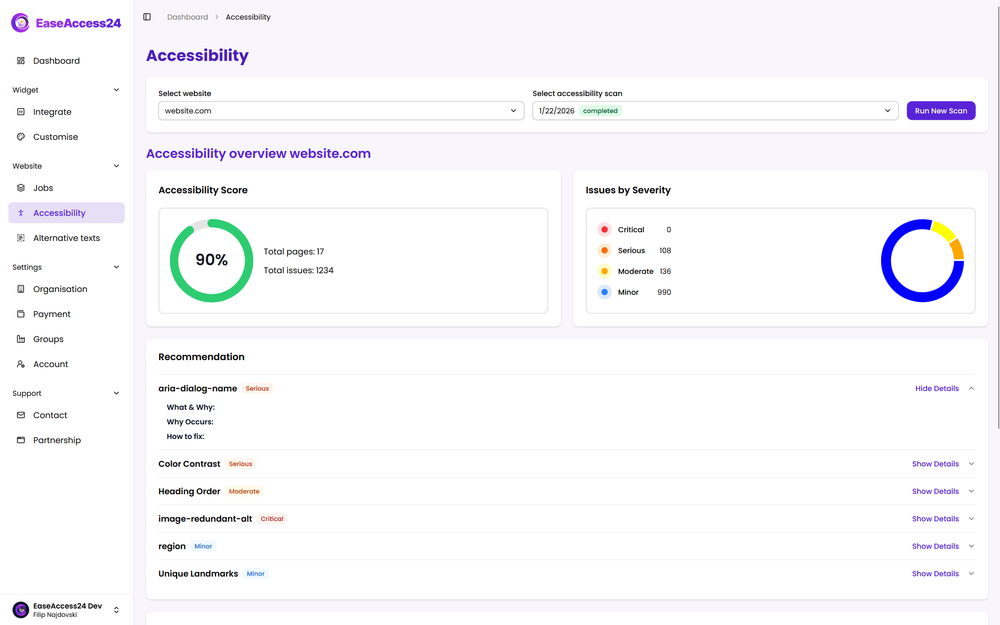
Understanding Scores vs. Real Compliance
One of the most common questions organisations ask is whether there is a specific accessibility percentage that guarantees compliance.
The short answer is no.
There is no single accessibility score that automatically makes a website compliant. Compliance is determined by whether your website meets the required WCAG success criteria — not by reaching a specific percentage.
Accessibility Score vs. Compliance
An accessibility score provides a helpful overview of your website’s current status. It reflects the proportion of detected issues relative to tested elements and gives you a measurable benchmark.
However, compliance is not based on averages.
Even if your score is high, a single critical violation of a required WCAG Level A or Level AA criterion can still result in non-compliance.
This is why focusing solely on the percentage can be misleading.
What Actually Determines Compliance?
Most regulations — including the European Accessibility Act and EN 301 549 — require conformance with WCAG 2.1 or WCAG 2.2 Level AA standards.
Compliance depends on:
• Whether required success criteria are met
• The severity of remaining issues
• The impact on users with disabilities
• Whether critical barriers remain unresolved
In other words, it is about resolving mandatory issues, not achieving a perfect score.
How EaseAccess24 Helps
EaseAccess24 does more than display a percentage.
The platform:
• Highlights required WCAG violations
• Categorises issues by severity
• Maps findings directly to specific WCAG criteria
• Distinguishes between minor improvements and compliance blockers
This ensures you understand which issues must be resolved to move toward compliance — not just how your score looks.
A Practical Approach to Compliance
Instead of aiming for an arbitrary number, organisations should focus on:
Identifying Level A and Level AA violations.
Prioritising high-severity accessibility barriers.
Implementing structured remediation.
Maintaining continuous monitoring.
An accessibility score is a useful indicator of progress — but true compliance comes from systematically addressing required standards.
Compliance is not about reaching 95% or 100%.
It is about removing barriers that prevent equal access.